Listen, then predict
Select a brief scene and read aloud until a character faces a choice. Pause before the next sentence; ask the child what might happen and why. Continue listening, then compare the prediction with the story.
Shared reading
A child may want the same story again just as an adult needs to finish another task. Voice playback can support a familiar reading routine, but the most useful moments still leave room to pause, talk, and turn pages together.

The best approach depends on a child's age, the material at hand, and whether an adult can join in.
Explore shorter listening sessions and picture-led conversation for younger children.
Understand what shared reading involves beyond hearing spoken words.
See classroom-oriented ways to pair listening with discussion and practice.
A voice can deliver words, but it cannot notice every puzzled look or decide what a particular child is ready to hear.
A child who listens quietly may still miss a character's motive or an unfamiliar word.
WorkaroundStop after a short passage and ask the child what happened in their own words.
A passage may contain frightening ideas, difficult vocabulary, or references that need context.
WorkaroundPreview the entire text and adjust it for the child's age and interests before playback.
Hearing a story does not grant the right to record, publish, or redistribute someone else's writing.
WorkaroundUse your own text or material you have permission to use, and keep private reading private.
Choose a small purpose first. Each routine gives a child something to do with the story rather than asking them only to listen.
Select a brief scene and read aloud until a character faces a choice. Pause before the next sentence; ask the child what might happen and why. Continue listening, then compare the prediction with the story.
Put the passage where the child can see it while they listen. Invite them to follow a repeated phrase with a finger, without turning the session into a speed test. An adult can point out a word the child recognizes.
Play or speak one short sentence, pause, and let the child say it back in their own voice. Talk about how changing the emphasis changes its feeling. Skip repetition if the child would rather discuss the picture.
Adult reading and voice playback are complementary options. This comparison helps you decide when to use each one.
Adult reading together
Conversation, comfort, and responsive storytelling
Prepared voice playback
Revisiting a short, already-checked passage
Adult reading together
Can change immediately when the child asks a question
Prepared voice playback
May need an adult to pause it at a useful point
Adult reading together
An adult can explain them in the child's terms
Prepared voice playback
The words are heard, but their meaning may remain unclear
Adult reading together
An adult can connect details in an image to the story
Prepared voice playback
Someone still needs to help the child look and notice
Adult reading together
Easy to vary expression during a conversation
Prepared voice playback
Useful for hearing the same wording again
Adult reading together
The reader can react to comments and questions
Prepared voice playback
A listening adult can pause and invite a response
Consider this tiny scene: A fox finds a mitten in the snow. Before the next line, ask, “Who might have dropped it?” The question matters more than finishing quickly.
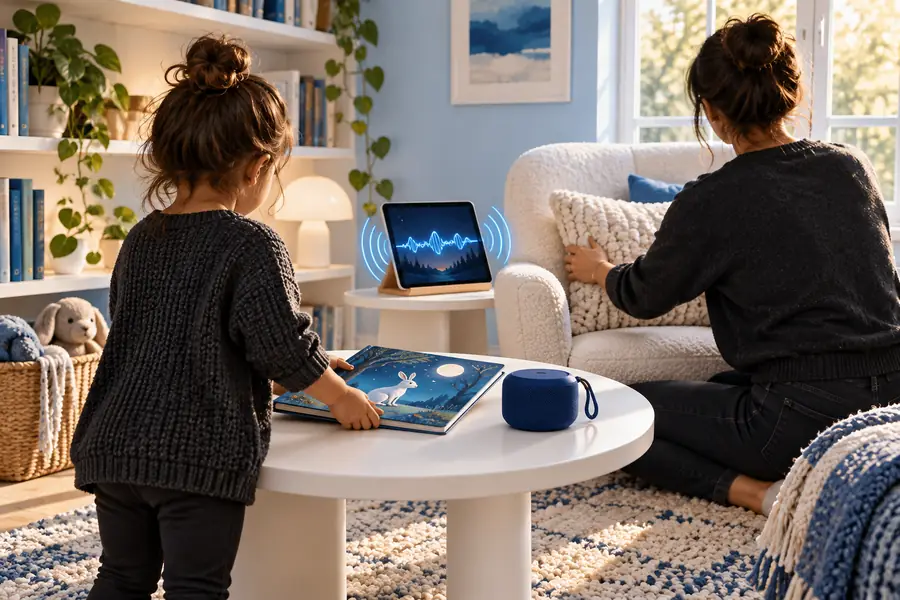

Illustrative images, not a captured product result. Preview any passage and make space for a child's answer before continuing.
Keep the text short enough to discuss, and treat a child's questions as part of the activity—not an interruption.
A picture book has more to notice than its printed sentences say.
Pause to name objects, invite guesses, and let the child point to details. For an age-specific routine, see this guide.
read aloud for preschoolThe child enjoys listening but rarely comments on the story.
Ask one open question after a short section rather than quizzing every page. This primer explains the wider activity.
what is read aloud for kidsStudents need a common passage before discussing a character's decision.
Preview the text, make the source available to students, and allow different ways to respond. These examples suggest classroom starting points.
read aloud examples for studentsChoose text you are allowed to use, check it before the child hears it, and be ready to pause. Readaloud can help you begin a voice-based reading session; an adult remains responsible for the material, the setting, and the conversation that follows.
Start with a story or short passage that suits the child's interests and feels comfortable to discuss. Preview it yourself, including the ending, before inviting the child to listen.
They can if it feels enjoyable and the words are visible. Younger children may prefer looking at pictures, while an older child might track a repeated phrase or notice where a sentence ends.
There is no single duration that fits every child or story. Start with a manageable section, pause for a response, and stop or switch activities when attention fades.
It can help a child hear a prepared passage again, but it cannot respond to their expression or explain a confusing moment on its own. When possible, listen together and make time for questions.
Stop and ask what they would rather hear or do. A different passage, an adult's voice, or simply talking about a picture may be a better choice that day.